

6 Costly Downtime Risks Caused by Poor Cable Management
Modern businesses depend on reliable electrical, data and communications infrastructure more than ever. Computers, servers, Wi-Fi systems, security equipment, phones, printers, access control systems and other connected devices all rely on cables working properly behind the scenes.
Yet cable management is often treated as an afterthought.
When cables are tangled, poorly labelled, unsupported or routed incorrectly, the result isn’t just an untidy communications room. Poor cable management can increase the risk of equipment faults, slow down maintenance, create safety hazards and contribute to costly business downtime.
For offices, commercial buildings, warehouses, retail environments and other workplaces, even a relatively short interruption can affect employees, customers, productivity and revenue.
Good cable management provides much more than a cleaner-looking installation. It helps create an organised infrastructure that is easier to maintain, troubleshoot and expand.
Here are 6 costly downtime risks caused by poor cable management and why professional cable installation and organisation should be part of every modern electrical and communications strategy.
1. Poor Cable Management Can Make Fault Finding Much Slower
When something stops working, the first priority is identifying the cause.
That’s much easier when cables are clearly organised, labelled and routed logically.
In a poorly managed installation, technicians may have to work through a mass of tangled cables to determine which connection belongs to which device, workstation, server or network system.
This can turn a relatively simple fault into a time-consuming investigation.
Imagine an office where one network connection stops working. In a professionally structured system, the cable can be traced back through an organised communications cabinet and identified quickly.
In a poorly organised cabinet, multiple cables may cross over one another, labels may be missing and connections may be difficult to trace.
The longer it takes to identify the problem, the longer the equipment may remain offline.
For businesses, that time can translate directly into lost productivity.
Good cable management therefore contributes to faster electrical and data fault finding, helping maintenance teams and technicians isolate issues more efficiently.
2. Tangled Cables Increase the Risk of Accidental Damage
Cables don’t just become messy when they’re poorly managed. They can also become vulnerable to physical damage.
Cables running across walkways, through crowded areas or around poorly organised equipment can be snagged, pulled, crushed or disconnected.
In offices and commercial environments, even minor physical damage can interrupt a critical connection.
For example, a cable may be accidentally pulled while equipment is moved, damaged when stored items are placed on top of it or disconnected when someone attempts to access another piece of equipment.
The result could be a loss of:
- Network connectivity
- Power
- Security equipment
- Communications systems
- CCTV
- Access control
- Specialist business equipment
The problem isn’t always the cable itself. Poor routing can make otherwise reliable infrastructure much more susceptible to accidental interference.
Professional cable management uses appropriate pathways, supports and routing methods to keep cabling organised and reduce unnecessary strain.
This helps protect the infrastructure from everyday workplace activity.
3. Poor Cable Management Can Contribute to Network Performance Problems
Businesses increasingly rely on structured data cabling for day-to-day operations.
Cloud applications, video conferencing, file sharing, VoIP phones, wireless access points and other digital services all depend on reliable network infrastructure.
Poor cable management can create physical and organisational issues within communications spaces.
Cables that are excessively bent, tightly compressed or improperly routed may be placed under unnecessary physical stress. In addition, poorly organised data cabling can make it more difficult to identify damaged connections or address performance issues.
Network problems aren’t always immediately obvious.
Employees may experience:
- Slow network speeds
- Intermittent connections
- Dropped calls
- Video conferencing disruptions
- Unreliable access to cloud services
- Devices repeatedly disconnecting
These issues can be frustrating because they may appear to be software or internet problems when the underlying cause is physical infrastructure.
Properly installed and organised structured cabling can help create a more dependable network environment and make future troubleshooting much easier.
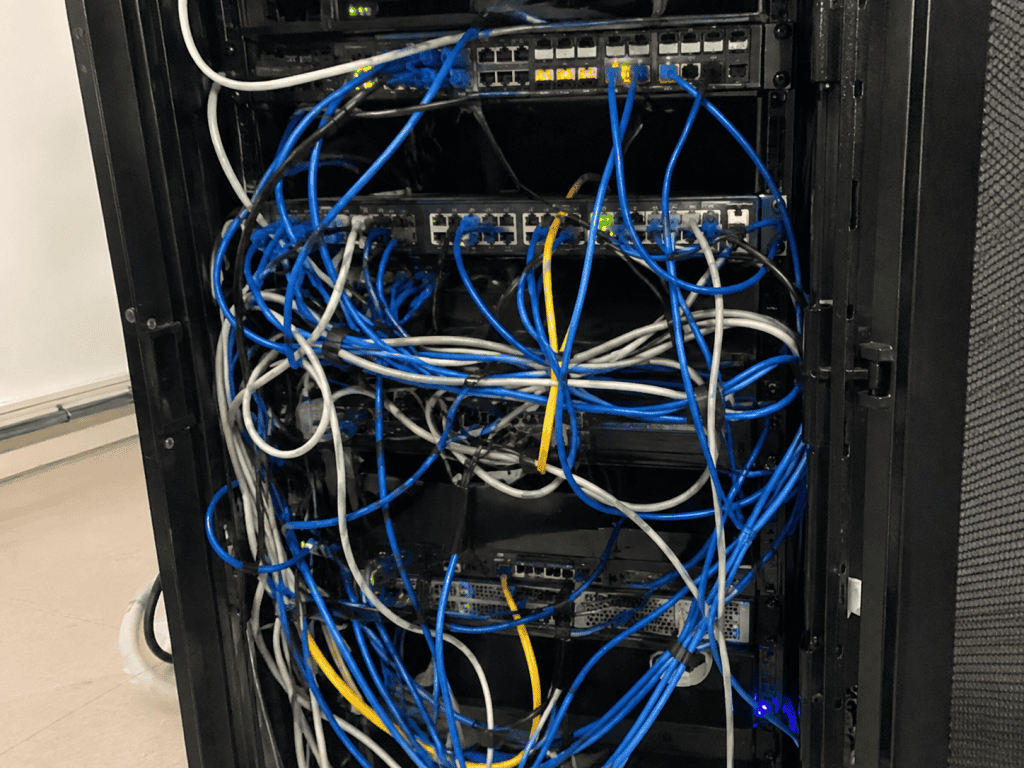
4. Disorganised Cables Make Maintenance More Disruptive
Every business eventually needs electrical or communications maintenance.
Equipment gets replaced, offices are rearranged and network infrastructure needs to be upgraded.
When cables are properly organised, these changes can often be carried out with less disruption.
Poor cable management has the opposite effect.
A technician may need to disconnect multiple cables simply to reach one connection. Equipment may need to be moved unnecessarily, and identifying which cables can safely be disconnected may take additional time.
This increases the chance of accidentally disconnecting equipment that wasn’t part of the original job.
In a busy workplace, that can quickly create an unexpected outage.
Good cable management makes infrastructure easier to access without interfering with unrelated systems.
This is particularly important in:
- Server rooms
- Communications cabinets
- Data centres
- Office fit-outs
- Retail premises
- Warehouses
- Medical facilities
- Large commercial buildings
The more connected a property is, the more important organised cabling becomes.
5. Poor Cable Management Can Increase Safety Risks
Downtime isn’t the only risk.
Badly managed cables can also create workplace safety hazards.
Loose cables on floors, walkways or work areas can create trip hazards for employees, contractors and visitors.
Cables that are improperly supported or routed can also be vulnerable to damage, particularly in areas where equipment, vehicles or stored materials are regularly moved.
Electrical cabling and communications cabling should be installed and managed appropriately for the environment in which they are being used.
A workplace that appears functional can still have infrastructure problems hiding behind desks, inside cabinets or above ceilings.
Addressing cable management isn’t simply about making a communications room look professional.
It can also help reduce avoidable physical hazards and protect the infrastructure itself from accidental damage.
6. Poor Cable Management Makes Future Upgrades More Expensive
Perhaps the biggest long-term cost comes when a business needs to expand.
Technology changes quickly.
A company may eventually need:
- Additional network points
- More wireless access points
- New CCTV cameras
- Access control systems
- Additional workstations
- New servers
- Updated communications infrastructure
- EV charging infrastructure
- Smart building technology
If the existing cabling is poorly organised, every upgrade becomes more complicated.
Technicians may need to spend additional time identifying existing connections, clearing access pathways and determining where new cables can be installed.
An already crowded communications cabinet can quickly become even more difficult to manage.
By contrast, a well-designed cable management system allows infrastructure to be expanded in a more controlled way.
Clear labelling, logical cable routes and properly organised communications equipment can make future upgrades easier and reduce unnecessary labour.
This is why cable management should be viewed as an investment in the future rather than simply an aesthetic improvement.
What Does Good Cable Management Look Like?
Effective cable management is about creating a system that is organised, accessible, secure and easy to understand.
Depending on the property and application, this can include appropriate:
- Cable trays
- Conduits
- Cable support systems
- Patch panels
- Labelling
- Communications cabinets
- Cable separation
- Routing pathways
- Cable ties or approved management solutions
- Documentation
The exact solution depends on the type of installation.
For example, the requirements of a small office will be very different from those of a large commercial building with extensive data, communications, security and electrical infrastructure.
The goal is to create an installation that works efficiently today while remaining practical to maintain tomorrow.
Why Structured Cabling Matters for Modern Businesses
Structured cabling provides a planned approach to a property’s data and communications infrastructure.
Instead of running cables wherever space happens to be available, the system is designed around the building’s current and future requirements.
This can make it easier to identify connections, add new equipment and diagnose faults.
A structured approach is especially valuable when businesses rely heavily on digital systems.
Modern workplaces can have dozens or hundreds of connected devices, making it increasingly difficult to manage infrastructure without a clear cabling strategy.
Good structured cabling and cable management work together to create a more scalable and maintainable communications environment.
How Poor Cable Management Can Increase Business Downtime
Downtime can have a much larger impact than the length of the outage itself.
Consider what can happen when critical systems go offline.
Employees may be unable to access files or cloud applications. Phones may stop working. Customers may be unable to complete transactions. Security systems may become unavailable. Staff may be forced to stop productive work while technicians investigate the issue.
Even a short outage can affect an entire team.
The longer it takes to locate and repair the fault, the greater the potential disruption.
This is why preventing avoidable infrastructure problems is so important.
Cable management won’t eliminate every possible network or electrical fault, but it can reduce some of the complications that make faults harder to locate, repair and prevent.
When Should a Business Review Its Cable Management?
A cable management review is worthwhile when an installation is becoming difficult to understand or maintain.
Warning signs may include:
- Tangled cables
- Missing labels
- Overcrowded communications cabinets
- Loose cables
- Frequent connection problems
- Difficulty tracing individual cables
- Repeated accidental disconnections
- Recent office expansions
- Major technology upgrades
- New security or communications systems
If several of these issues are present, the business may benefit from having its cabling infrastructure professionally assessed.
A review can help identify immediate problems while also highlighting opportunities to improve the system for future growth.
Speak to Spectra Electrical About Cable Management and Communications
Don’t wait for a cabling fault to bring your business to a standstill.
Spectra Electrical can assist businesses and commercial properties with electrical, data and communications infrastructure, including professional cabling installation, cable management and infrastructure upgrades.
If your communications cabinet is overcrowded, cables are difficult to trace, network connections are becoming unreliable or your business is preparing for an expansion, now is the time to address the underlying infrastructure.
A professional cable management assessment can help identify problem areas, improve organisation and create a more practical system for future maintenance and upgrades.
Whether you’re planning an office fit-out, upgrading an existing network, expanding your commercial premises or simply trying to eliminate unnecessary downtime, Spectra Electrical can help you build a cleaner, more organised and future-ready cabling solution.
Contact Spectra Electrical today to discuss your cable management requirements and take the first step towards a more reliable and maintainable electrical and communications infrastructure.
Conclusion
Poor cable management can create much more than an untidy workspace.
From slower fault finding and accidental cable damage to network performance problems, maintenance disruptions, safety hazards and expensive future upgrades, disorganised cabling can contribute to costly business downtime.
The solution is to treat cable management as an important part of your electrical and communications infrastructure from the beginning.
Organised, clearly labelled and professionally installed cabling makes systems easier to maintain, easier to troubleshoot and easier to expand.
For businesses that rely on technology every day, that can make a significant difference.
Instead of waiting for a cable-related fault to bring operations to a standstill, consider reviewing your existing infrastructure now. Investing in better cable management today can help create a more reliable, maintainable and future-ready workplace tomorrow.