
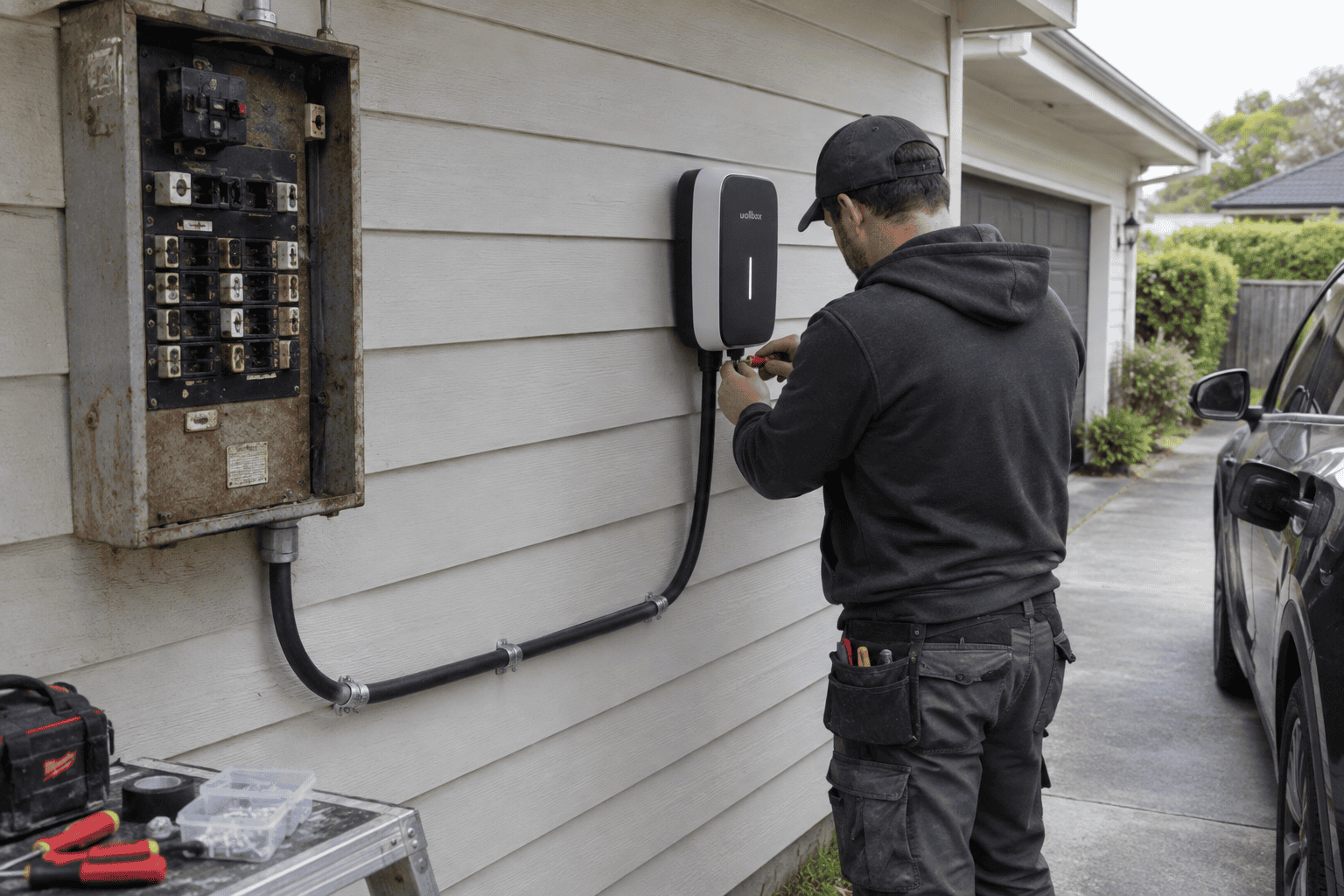
6 Dangerous EV Charging Setups That Overload Old Switchboards
Electric vehicles are becoming an increasingly popular choice for Australian drivers, and home charging is one of the biggest conveniences of EV ownership. Instead of relying on public charging stations, homeowners can charge their vehicle while it’s parked overnight or during the day.
But installing an EV charger isn’t simply a matter of choosing a wall-mounted unit and connecting it to whatever electrical infrastructure already exists.
Older homes can have switchboards and electrical supplies that were designed long before EV charging became part of everyday household electricity demand. Adding a high-demand charger without properly assessing the existing installation can place additional stress on an already limited system.
NSW Government guidance specifically notes that installing a major new electrical appliance such as an EV charger can be a reason a switchboard upgrade is required, particularly in older homes with ageing or lower-capacity panels.
The issue isn’t that EV charging is inherently unsafe. The problem occurs when the charging setup isn’t properly matched to the property’s electrical infrastructure.
Here are 6 dangerous EV charging setups that overload old switchboards and what homeowners should know before installation.
1. Installing a High-Powered Charger on an Ageing Switchboard
One of the biggest risks is installing a high-powered EV charger without first assessing the condition and capacity of the existing switchboard.
Older switchboards may have been designed around a much smaller electrical load.
A home built decades ago may have originally supplied lighting, a refrigerator, basic kitchen appliances and a few power points. Modern homes can now have air conditioning, induction cooking, pool equipment, home offices, large entertainment systems and an EV charger operating within the same property.
Why EV Charging Changes the Equation
A dedicated EV charger can add a substantial new electrical load to the home.
If the existing switchboard is already approaching its practical limits, introducing another significant load can increase the likelihood of protective devices operating or reveal other weaknesses in the installation.
This doesn’t automatically mean an older switchboard cannot support EV charging.
It means the electrical system should be assessed first.
A licensed electrician can evaluate the existing switchboard, electrical supply and proposed charger before recommending an installation approach.
2. Treating an Empty Switchboard Space as Available Capacity
An empty space in a switchboard can look like an invitation to install another circuit.
But physical space and electrical capacity are two very different things.
A switchboard may have room for another protective device while the property’s supply has limited capacity for additional demand.
Why the Difference Matters
Imagine an older home with an apparently spacious switchboard.
The homeowner assumes there is plenty of capacity because several spaces are unused. However, the existing electrical installation may already be carrying substantial loads from air conditioning, hot water, cooking appliances and other equipment.
Adding an EV charger could push overall demand higher than the system was designed or configured to handle.
This is why an electrician needs to consider the broader installation rather than simply looking for a spare space.
NSW Government guidance for EV charging projects also recommends assessing available electrical capacity rather than relying solely on the physical availability of circuit-breaker spaces.
3. Using a High-Powered Charger Alongside Several Major Appliances
Another risky setup occurs when an EV charger operates at high power while the home is simultaneously using several other energy-intensive appliances.
For example, the vehicle may be charging while:
- An air conditioner is running
- An electric hot water system is operating
- An induction cooktop is being used
- A pool pump is running
- A clothes dryer is operating
- Other high-demand appliances are being used
Any individual appliance might be perfectly normal.
The problem is the combined electrical demand.
The Importance of Diversity
Households don’t always use every major appliance at maximum demand simultaneously. However, EV charging can add a significant load for several hours at a time.
A well-planned installation considers how charging fits into the property’s normal electricity consumption.
Depending on the equipment and installation, smart charging or load management may also be worth considering.
These approaches can help manage charging around other household demand rather than simply assuming the charger should operate at its maximum output whenever the vehicle is connected.
4. Installing an EV Charger Without Considering the Property’s Electrical Supply
The switchboard is only one part of the equation.
The property’s wider electrical supply also needs to be considered.
An older home may have a supply arrangement that was perfectly adequate for the original electrical demand but is less suitable for significant new loads.
When the Supply May Need Attention
A larger electrical upgrade may need to be considered when:
- The property already has high electrical demand
- Multiple major appliances operate together
- The existing switchboard is outdated
- The available electrical supply is limited
- The homeowner is planning additional major electrical upgrades
- A second EV may be added in the future
NSW Government guidance states that increasing the amount of power a property can use, including for an EV charger or other large appliances, may require changes to the property’s electricity supply and may involve an Accredited Service Provider.
This is why EV charging should be considered as part of the property’s broader electrical system.
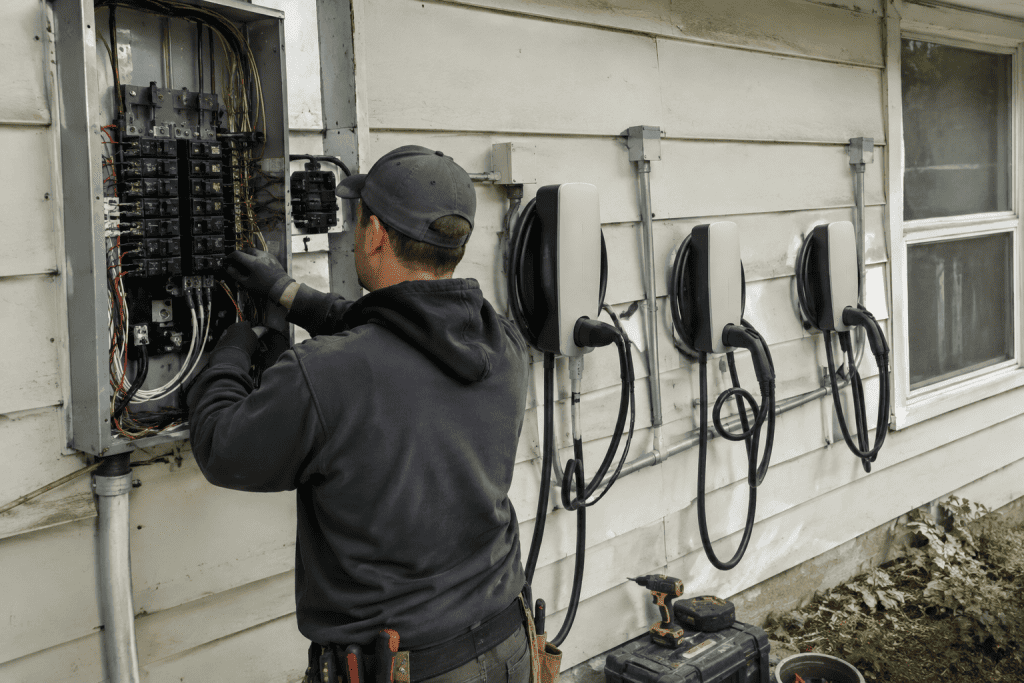
5. Installing Multiple EV Chargers on an Old Residential Electrical System
One EV charger can already represent a significant new electrical load.
Two or more chargers can change the equation considerably.
This is becoming increasingly relevant as households consider owning multiple EVs or as shared residential properties explore charging infrastructure.
Two Cars Don’t Necessarily Mean Two Full-Power Chargers
Installing separate high-powered chargers for two vehicles without considering the property’s overall electrical capacity can create unnecessary pressure on the electrical system.
A smarter approach is to assess how the vehicles will actually be used.
For example, one vehicle might need regular overnight charging while the second may only require occasional top-ups.
The charging strategy can therefore be designed around actual demand rather than simply installing the maximum possible charging capacity for every vehicle.
This is particularly important in strata buildings, where multiple EV chargers may need to share limited building infrastructure.
NSW guidance for residential strata properties specifically recommends determining whether there is sufficient electrical capacity in switchboards and wiring before proceeding with EV charging infrastructure.
6. Choosing the Charger First and Checking the Electrical System Later
Perhaps the most expensive mistake is purchasing an EV charger before understanding whether the property is ready for it.
Homeowners often start by comparing charger brands, charging speeds, apps and features.
Those things matter, but the electrical infrastructure should come first.
The Property Should Drive the Charging Solution
A better process is:
Assess the property → understand electrical capacity → determine charging requirements → select appropriate equipment → install professionally.
Starting with the charger can lead to unexpected costs if the existing switchboard, supply or cabling needs additional work.
A homeowner may purchase a high-powered unit expecting a straightforward installation, only to discover that their property requires an electrical upgrade before it can be safely accommodated.
A professional assessment at the beginning can make the entire process easier to plan and budget.
What Happens When an EV Charger Overloads an Old Switchboard?
An overloaded or unsuitable electrical system doesn’t necessarily fail dramatically.
In some cases, a protective device may trip and interrupt power to the charging circuit or other parts of the property.
Repeated operation of protective devices should not simply be treated as an inconvenience.
It can indicate that the electrical installation is experiencing a problem, excessive demand or another condition that requires investigation.
Warning Signs to Watch For
After an EV charger is installed, homeowners should take notice of:
- The charger repeatedly stopping unexpectedly
- Circuit breakers repeatedly operating
- Safety switches repeatedly operating
- Unusual heat around electrical equipment
- Burning or unusual smells
- Flickering lights
- Other circuits losing power while charging
These signs don’t necessarily prove that the EV charger is overloading the switchboard, but they are reasons to stop assuming everything is operating normally.
Have the system assessed by a licensed electrician.
Why Older Switchboards Deserve Extra Attention
Age alone doesn’t mean a switchboard is unsafe.
Some older installations have been well maintained and remain suitable for their purpose.
The concern is that older switchboards may have been designed for electrical demand that no longer reflects how the property is used.
Modern homes can combine EV charging with:
- Solar panels
- Battery storage
- Air conditioning
- Induction cooking
- Heat pumps
- Pool equipment
- Home offices
- Smart home technology
The more electrical technology added to a property, the more important it becomes to understand the capacity and condition of the underlying electrical infrastructure.
Don’t Assume a Slower Charger Is Always the Solution
It can be tempting to conclude that reducing charging speed automatically solves an electrical capacity issue.
Sometimes a lower-power charging setup may be appropriate, but the existing electrical installation still needs to be assessed.
The right solution depends on the property, charger, available capacity and how the vehicle will be used.
The objective is not simply to find the lowest possible charging load.
It is to create an EV charging system that is practical, safe and appropriate for the home’s electrical infrastructure.
Have Your Electrical System Assessed Before Buying the Charger
An electrical assessment before purchasing an EV charger can answer several important questions.
How Much Capacity Does the Property Have?
This helps determine whether the planned charger can be accommodated alongside existing household demand.
Is the Switchboard Suitable?
The switchboard may require maintenance, additional protection or upgrading depending on its condition and configuration.
Where Should the Charger Be Installed?
The physical location affects cable routing, installation complexity and the overall practicality of the charging setup.
Should Future Demand Be Considered?
If you may add another EV, solar battery storage or other major electrical equipment, it can make sense to consider those plans now.
Speak to Spectra Electrical About EV Charger Installation
Spectra Electrical can assist homeowners with EV charger installations and the electrical infrastructure required to support them.
If you have an older switchboard, are considering a higher-powered charger or simply aren’t sure whether your home has enough electrical capacity, getting the property professionally assessed before installation can help avoid unexpected problems.
Spectra Electrical can assess your existing electrical infrastructure and help determine what needs to be considered before an EV charger is installed.
Don’t buy the charger first and worry about the switchboard later. Contact Spectra Electrical to discuss your EV charging requirements, assess your home’s electrical capacity and plan an installation that works with your existing system.
Whether you need a straightforward home charger installation, switchboard improvements or advice about future electrical demand, getting the electrical planning right from the beginning can save you from costly upgrades and unnecessary disruption later.
Make EV Charging Part of Your Long-Term Electrical Plan
An EV charger should be viewed as part of the home’s wider electrical system rather than an isolated appliance.
The best charging setup is one that works alongside everything else the property already needs.
As homes become more electrified, this approach will become increasingly important.
A property may eventually have an EV, another EV for a second driver, solar, battery storage, electric hot water and other high-demand technology.
Planning the electrical infrastructure around those future needs can make upgrades easier and reduce the likelihood of repeatedly modifying the system.
Conclusion
EV charging can make electric vehicle ownership significantly more convenient, but the charging setup needs to be matched to the home’s electrical infrastructure.
The biggest risks occur when homeowners install high-powered chargers on ageing switchboards, assume an empty breaker space means available capacity, combine charging with excessive household demand or install multiple chargers without assessing the property’s overall supply.
An old switchboard isn’t automatically a problem, and not every EV installation requires a major electrical upgrade.
The important step is to assess the property before installation.
A professional electrical assessment can determine whether the existing switchboard and supply are suitable, whether additional infrastructure is required and what charging approach makes sense for the way the household actually uses its vehicles.
The smartest EV charging installation isn’t necessarily the fastest charger available—it’s the one that safely fits the electrical system supporting it.
