
11 Critical Data Cabling Standards Every Fitout Must Meet
A modern commercial fitout needs much more than attractive interiors, efficient lighting and conveniently positioned power points. Behind the walls and ceilings is a communications network that supports computers, phones, Wi-Fi, security systems, access control, video conferencing and countless other connected technologies.
That makes data cabling standards an important part of every office, commercial building and major fitout project.
Poorly designed or incorrectly installed data cabling can create frustrating connectivity problems, make future upgrades more difficult and leave businesses with expensive rework. By contrast, structured cabling designed and installed correctly can provide a reliable foundation for today’s technology while allowing the network to evolve as the business grows.
In Australia, telecommunications cabling is subject to specific regulatory requirements. ACMA states that customer cabling work must comply with the relevant cabling rules and standards, including AS/CA S009:2020 and the applicable requirements for cabling products. Registered cablers are also required for relevant telecommunications cabling work.
It is important to distinguish between mandatory regulatory requirements and additional project specifications. Not every commercial fitout will have exactly the same cable category, fibre requirements or performance specification.
With that in mind, here are 11 critical data cabling standards every fitout must meet.
1. Use a Registered Cabler for Telecommunications Cabling
The first requirement has nothing to do with cable category. It is about who performs the work.
Under Australia’s current cabling framework, telecommunications cabling work must be performed or appropriately supervised by a registered cabler with the relevant registration and competencies.
Why This Matters
A professional fitout may involve structured data cabling, fibre optics, security systems, communications infrastructure and other cabling applications.
Using the correct registered professional helps ensure the installation is carried out within the applicable regulatory framework.
It also gives the business important documentation at completion. ACMA requires a certification statement to be prepared after relevant cabling work is completed, confirming that the work complies with AS/CA S009:2020.
Choosing an appropriately registered cabler should therefore be one of the first decisions made during a commercial fitout.
2. Follow AS/CA S009:2020 Installation Requirements
AS/CA S009:2020 Installation Requirements for Customer Cabling is one of the key standards governing telecommunications cabling installation in Australia.
It covers fixed or concealed customer cabling connected, or intended to be connected, to a telecommunications network.
What S009 Covers
The standard addresses important installation considerations including safety, cable routing, separation from other services, installation environments, support, terminations and other requirements.
This matters because a data cable is not simply something that can be run wherever there happens to be space.
The cable needs to be installed in a way that protects its performance, the people working around it and the wider telecommunications network.
For a commercial fitout, compliance with the Wiring Rules should be considered during design rather than after installation.
3. Select Cabling Products That Meet the Applicable Requirements
Installing the correct cable isn’t enough if the other components don’t meet the required specification.
Connectors, patch panels and other customer cabling products also need to be appropriate for the application.
ACMA’s current framework references AS/CA S008:2020 Requirements for Customer Cabling Products, with the ACMA Telecommunications (Requirements for Customer Cabling Products – AS/CA S008) Technical Standard 2025 adopting the industry standard.
Why Component Quality Matters
A structured cabling system works as a complete channel.
Using high-quality cable with unsuitable connecting hardware can undermine the performance of the entire installation.
Commercial fitouts should therefore consider the complete cabling system rather than purchasing individual components based purely on price.
4. Maintain Appropriate Separation From Electrical Power
One of the most important installation considerations is the relationship between data cabling and electrical power cabling.
Poor separation can create safety issues and, depending on the installation, can also affect communications performance.
AS/CA S009:2020 contains requirements covering separation between customer cabling and electrical services.
Plan Cable Routes Before Construction
This is particularly important in ceilings, risers, wall cavities, communications rooms and service corridors where multiple building services compete for limited space.
Electrical, mechanical, plumbing and communications pathways should be considered together during the design stage.
A fitout that leaves data cabling until the end can quickly create congested service routes and expensive rework.
5. Follow the Correct Cable Routing and Support Requirements
Data cabling needs to be installed in a way that protects it from physical damage and unnecessary stress.
Cables should not simply be thrown above ceilings or left hanging between services.
Good Cable Management Matters
A professional installation considers:
- Cable support
- Routing pathways
- Access for maintenance
- Protection from damage
- Separation from incompatible services
- Future expansion
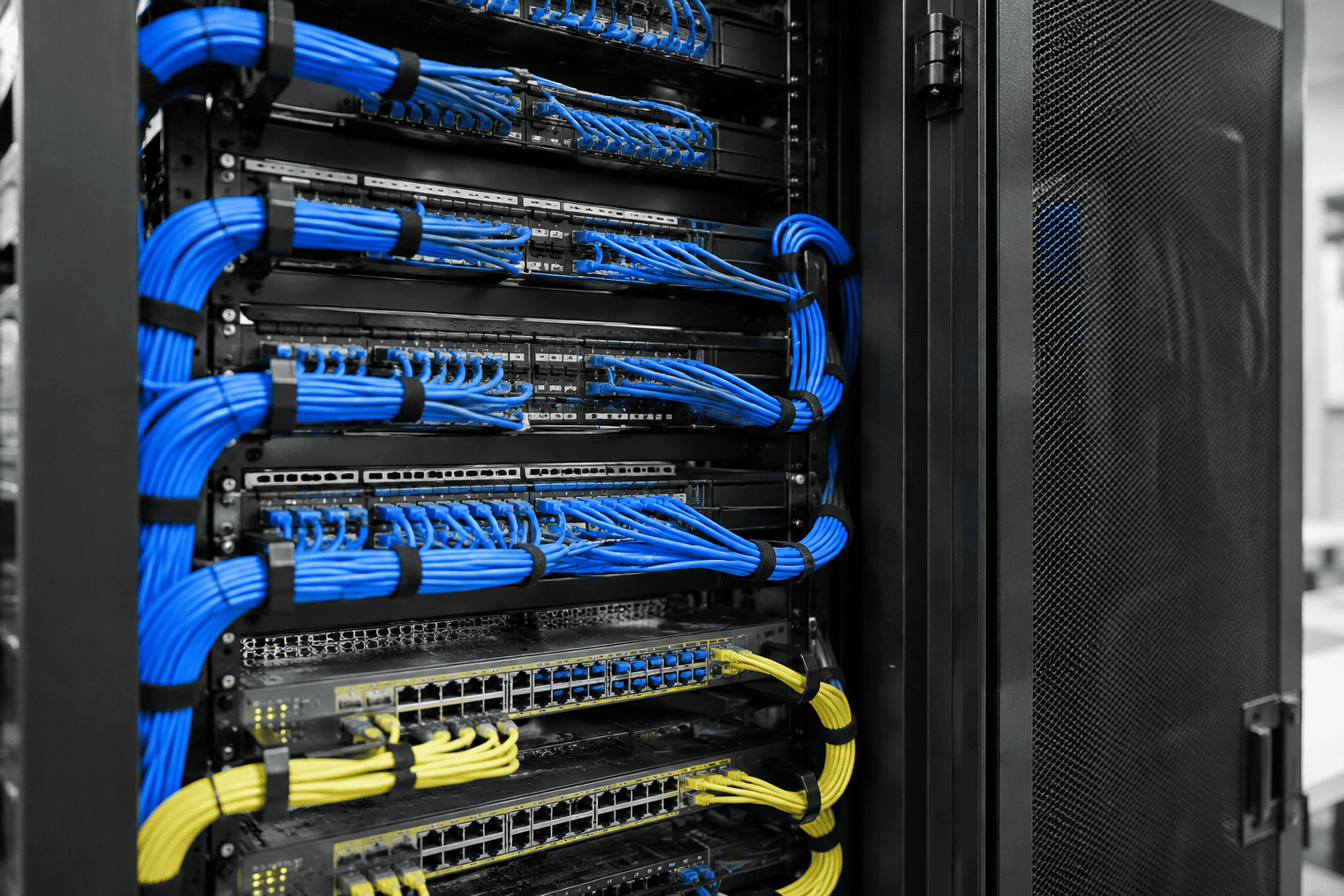
- Identification of individual cables
Good cable management isn’t just about appearance.
An organised system is easier to troubleshoot and modify when the business adds new equipment, moves workstations or expands the network.
6. Respect Cable Bend and Installation Requirements
Data cables contain carefully manufactured conductors and internal structures designed to achieve specific transmission performance.
Excessive bending, crushing, pulling or other physical stress can affect that performance.
Don’t Compromise the Cable During Installation
The correct installation approach depends on the cable type and manufacturer requirements.
A professional installer should follow the manufacturer’s specifications for pulling tension, bend radius and other handling requirements.
This becomes particularly important with higher-performance copper cabling and optical fibre, where installation practices can influence final performance.
A cable that looks perfectly normal from the outside may still have suffered physical damage during installation.
7. Choose the Right Category and Performance Class
Not every fitout needs exactly the same data cabling.
The correct specification depends on the building, network equipment, application and expected future requirements.
Common copper options include Cat 6 and Cat 6A, while fibre may be appropriate for backbone connections, longer distances or high-capacity applications.
Don’t Choose Cable Based Only on Price
A business might save money by selecting a lower specification today, only to discover that the infrastructure cannot support a future technology upgrade.
Structured cabling should therefore be designed around the required performance rather than simply choosing the cheapest available product.
Where the project requires it, AS/NZS 11801 provides a framework for generic cabling systems and performance requirements.
For larger commercial projects, the cabling specification should be established during design and documented clearly before installation begins.
8. Separate Data Infrastructure From Other Hazardous Services
Commercial buildings contain far more than electrical power.
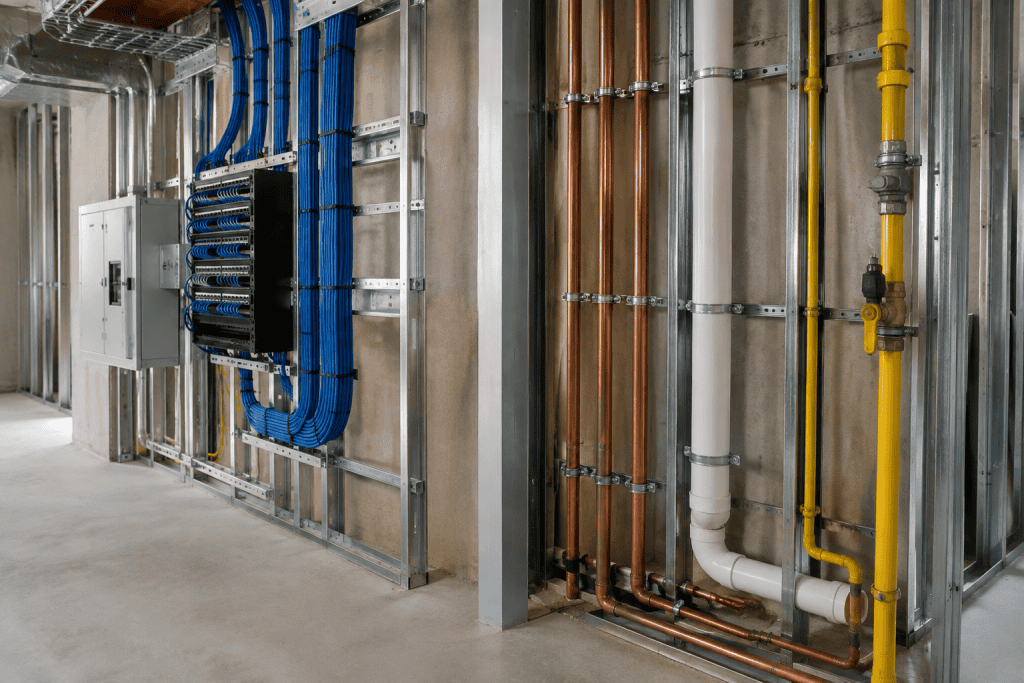
Data cables can encounter services such as plumbing, gas, high-temperature pipework and other potentially hazardous infrastructure.
Service Coordination Is Essential
Poorly planned cabling routes can create accessibility, safety and maintenance problems.
During the fitout design stage, cable routes should be coordinated with other building services to ensure the finished installation does not compromise other systems.
This is particularly important in congested ceiling spaces, communications risers, plant rooms and service cupboards.
The objective is not simply to find an empty pathway.
It is to create a safe and maintainable pathway that works with the rest of the building.
9. Test the Completed Cabling Properly
Installing hundreds of data outlets isn’t enough.
A professional structured cabling installation should be appropriately tested to verify that the installed links perform as intended.
Why Testing Matters
Testing can identify problems such as:
- Incorrect terminations
- Wiring faults
- Damaged cables
- Poor connections
- Performance issues
- Incorrect patching
- Installation problems
Without appropriate testing, a business may only discover a problem once employees begin using the network.
For major commercial projects, the testing requirements should be established within the project specification and matched to the selected cabling system.
10. Label and Document the Installation
Imagine opening a communications cabinet years after a fitout and finding dozens of cables with no clear identification.
What should be a straightforward change can become a frustrating tracing exercise.
Good Labelling Saves Time
A professional installation should have a logical identification system linking outlets, patch panels and relevant equipment.
The cabling regulatory framework also contains requirements around certification and labelling.
ACMA requires certification statements to be provided after relevant cabling work, identifying the completed work and confirming compliance with AS/CA S009:2020.
For larger fitouts, good documentation should also include useful project information such as outlet schedules, rack layouts and other relevant records.
11. Design the Cabling for Future Expansion
One of the biggest mistakes during a commercial fitout is designing the network only for the number of employees and devices that exist today.
Businesses change.
They hire new employees, rearrange offices, install more security cameras, add wireless access points and introduce new technology.
Build Flexibility Into the Design
A future-ready structured cabling system should consider potential expansion in areas such as:
- Additional data outlets
- Wi-Fi access points
- CCTV
- Access control
- VoIP phones
- Meeting rooms
- Server infrastructure
- Fibre backbones
- Building technology
Designing some flexibility into the system during the original fitout can be considerably easier than adding infrastructure after walls, ceilings and finishes are complete.
Why Data Cabling Standards Matter in Commercial Fitouts
It can be tempting to think of data cabling as something that happens behind the scenes and therefore doesn’t require much attention.
In reality, the opposite is often true.
The cabling infrastructure installed during a fitout can remain in place for many years.
If it has been poorly planned, businesses can be left dealing with recurring connectivity problems, difficult maintenance and expensive upgrades.
A well-designed installation gives the business a much stronger foundation.
Don’t Leave Data Cabling Until the End of the Fitout
Data cabling should be incorporated into the project from the design stage.
Waiting until walls and ceilings are almost finished can make cable routes harder to access and increase the likelihood of clashes with other building services.
Early coordination allows the electrical contractor, data cabler, builder, architect and other trades to agree on practical pathways and equipment locations.
Better Planning Creates Better Infrastructure
Early planning can help coordinate:
- Communications rooms
- Rack locations
- Cable pathways
- Data outlet positions
- Fibre requirements
- Wi-Fi access points
- CCTV
- Security systems
- Future expansion
This can reduce rework and help the completed network integrate more effectively with the building.
Speak to Spectra Electrical About Data Cabling
Spectra Electrical can assist businesses, builders and commercial property owners with data and communications infrastructure as part of office fitouts, commercial upgrades and broader electrical projects.
Whether you’re designing a new workplace, refurbishing an existing office or upgrading an ageing communications network, getting the cabling plan right early can make a significant difference to the finished result.
From structured data cabling and cable management to communications infrastructure and electrical coordination, Spectra Electrical can help create a professional, organised and future-ready installation.
Planning a commercial fitout? Contact Spectra Electrical early to discuss your data cabling requirements, coordinate infrastructure with the wider project and establish a cabling solution designed around both today’s technology and tomorrow’s growth.
Build Your Fitout Around Reliable Infrastructure
A modern workplace depends on its communications infrastructure every bit as much as its desks, lighting and air conditioning.
Poor cabling can remain hidden for years, only becoming obvious when the business experiences connectivity problems or tries to upgrade its technology.
That is why standards, professional installation, testing and documentation matter.
Conclusion
Data cabling is one of the most important hidden components of a modern commercial fitout.
From using registered cablers and compliant products to following AS/CA S009:2020, maintaining appropriate service separation, selecting suitable cable performance, testing completed links and documenting the installation, each stage contributes to the reliability of the finished network.
Not every fitout will have identical cabling requirements. The appropriate specification depends on the building, technology, network architecture and project brief.
The smartest approach is to establish those requirements before installation begins.
A well-planned data cabling system can give your business a reliable communications foundation, simplify future maintenance and provide the flexibility needed as technology and the workplace continue to evolve.
